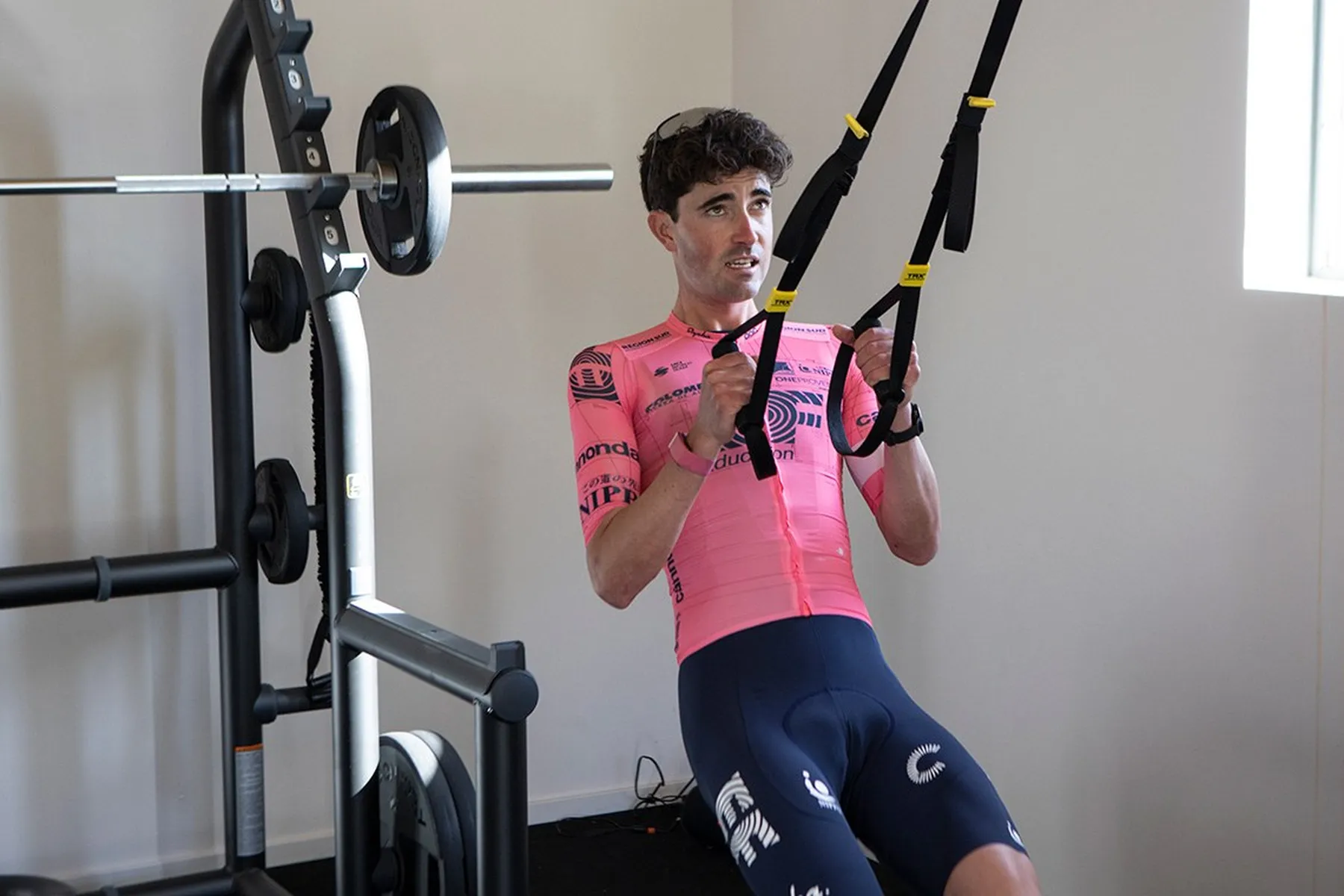
Cycling has a long history of treating the gym with suspicion. Coaches warned about adding unnecessary mass. Riders worried about wasting energy on exercises that don't involve a saddle. That scepticism has been largely dismantled by a decade of controlled research and by the practical experience of coaches working at the highest levels of the sport.
The debate isn't really about whether cyclists should lift. It's about how heavy, how often, and when. The answers from sports scientists and S&C coaches point in the same direction.
The consensus: loaded resistance work beats more volume after 35
Bjørn Rønnestad's work at Inland Norway University of Applied Sciences has been the anchor for most of the evidence-based discussion over the past fifteen years. Across multiple studies, Rønnestad compared heavy resistance training at 4–10 repetition maximums against moderate or high-repetition protocols in trained cyclists. The heavy loading group consistently showed greater improvements in cycling economy, mean power output, and time-to-exhaustion. The neuromuscular explanation is simple: meaningful load recruits more motor units and increases rate of force development in ways that translate directly to the pedal stroke.
Prof. Stephen Seiler, whose research on polarised training Anthony has discussed at length on the podcast, makes a related point about the physiology of masters athletes. After 35, two processes compound each other. Muscle fibre quality declines, particularly fast-twitch type II fibres. And neuromuscular efficiency — the ability to coordinate and activate muscle — deteriorates without stimulus. Endurance training alone does not arrest either process. Loaded resistance training does.
Joe Friel has documented this extensively. In his work with masters cyclists, riders who committed to two or more gym sessions per week through the off-season retained significantly more top-end power entering the race season than those who skipped strength work entirely. The gap widened with age. A 38-year-old who skips the gym through winter is starting February behind where they left off in October. A 50-year-old in the same position is starting considerably further back.
The practical translation for an amateur cyclist is direct: loaded resistance work in the 6-10 rep range, with 2-3 reps in reserve on the working sets, is the dose that drives the adaptations the research has documented. That window is heavy enough to recruit fast-twitch fibres and progress strength without the spinal load and injury risk of all-out 1RM lifting. The notion that high-rep, low-load circuits are "safer" or more "cycling-specific" is not supported by the outcome data.
The minimum effective dose
Two sessions per week. That figure appears consistently across Rønnestad's protocols, in coaching practice at World Tour level, and in the guidance S&C coaches give amateur athletes. Below two sessions, the stimulus is insufficient for measurable strength gains. Above three, accumulated fatigue starts to compromise the quality of on-bike training.
Derek Teel, who coaches elite cyclists and has been on the podcast to walk through his approach in detail, makes the point that the minimum effective dose depends on what each session contains. Two sessions of cycling-specific patterns loaded with intent produce very different outcomes than two sessions of band work and bodyweight lunges. The load has to be there. Otherwise you're going through the motions and calling it strength training.
A practical minimum-dose week for a cyclist in early base phase looks like this: two sessions, three to four cycling-specific patterns each (split squat, hip hinge, single-leg deadlift, hip thrust, press or pull, core), working at a load that challenges in the 6-10 rep range with 2-3 reps in reserve, with three to four sets per primary pattern. Total gym time per session sits around 45–60 minutes. This leaves ample capacity for three to five bike sessions per week without the gym becoming the limiting factor.
The question of what counts as an adequate load is worth addressing directly. If you can perform 12-plus clean reps with a given weight in good form, the load is too light to produce the neuromuscular adaptations relevant to cycling performance. The last two reps of each working set should require real concentration. Sets of 20 light squats produce muscular endurance, not strength, and muscular endurance is not the limiting factor in most cyclists' performance after the first few months of riding.
If you're looking for a structured S&C plan that applies these principles across a full training cycle, the Roadman Coaching programme builds it around the five pillars including strength from day one.
In-season vs off-season programming
The off-season and early base phase are when the loaded work happens. This is the period when bike volume is low, intensity is controlled, and the body can absorb the systemic load of progressive resistance training. Rønnestad's standard research protocol runs eight to twelve weeks of this phase, with progressive overload across the block, before transitioning to a maintenance phase when racing or high-intensity cycling resumes.
In-season, the goal changes. You are not trying to build new strength. You are trying to preserve the adaptations built during the base phase while the bike carries the primary training load. One session per week, three to four sets per pattern at the same 6-10 rep range with reps in reserve, achieves this. Rønnestad's data shows that dropping to one session per week does not produce measurable detraining in strength or power output over an eight-week period, provided the load remains meaningful.
What causes problems in-season is not the frequency of gym sessions. It's the timing. A loaded lower-body session 48 hours before a race or a high-intensity bike interval session will blunt performance on the bike. Most coaches recommend placing the single in-season gym session immediately after the hardest training day of the week, giving maximum separation before the next key session. Some athletes place it same-day as a hard ride, completing the gym work first when neuromuscular freshness matters.
Understanding how to sequence this properly is part of what periodisation means in practice. The structure of the year has to account for when strength adaptations are built, when they are maintained, and when, during the peak racing period, even the maintenance session gets dropped for two to three weeks without penalty.
The exercises every expert recommends
The specifics vary by coach and athlete, but the same movement patterns appear across virtually every expert recommendation: loaded single-leg work, hip-hinge patterns for the posterior chain, and some form of upper body pulling to balance the forward-leaning position on the bike.
Single-leg work is prioritised because cycling is a unilateral sport. The pedal stroke is alternating. Most cyclists have measurable asymmetries between left and right sides. Bulgarian split squats, single-leg deadlifts, single-leg press, and rear-foot-elevated step-ups all address this directly. They also require lower absolute loads than bilateral exercises, which reduces spinal loading — a relevant consideration for athletes who spend 10–20 hours per week in a compressed cycling position.
Hip-hinge patterns — single-leg deadlifts, kettlebell deadlifts, hip thrusts — build the posterior chain strength that transfers to generating force through the hip extensors at high power outputs. The single-leg variations directly mirror the pedal stroke; the hip thrust isolates the glutes with very low spine loading. These patterns deliver the cycling-specific stimulus without the injury risk of all-out heavy bilateral barbell work.
For a more detailed breakdown of specific exercise selection, Derek Teel's best exercises episode covers his full hierarchy of movement choices, with the rationale for each.
The single-leg deadlift deserves specific mention. It trains the hamstrings and glutes in a lengthened position, which is the position they are loaded in during the downstroke, and it does so one leg at a time — exactly how the bike loads them. Most cyclists' hamstrings are comparatively undertrained relative to their quadriceps, and the single-leg deadlift addresses this imbalance directly while keeping spinal load low.
Upper body pulling — single-arm dumbbell row, seated cable row, chest-supported row — is not about adding power to the pedal stroke. It addresses postural fatigue. A cyclist who reaches hour four of a long ride with a fatigued upper back is not holding an efficient position. Pulling work builds the capacity to maintain that position.
What experts say about core training
The term "core training" covers a wide range of activities with very different outcomes. Pilates, functional movement, stability work, plank variations, anti-rotation exercises — these are not equivalent, and treating them as interchangeable produces confused programming.
The S&C consensus for cyclists is that core training should be anti-movement: exercises that resist unwanted motion rather than produce it. Anti-rotation presses, Pallof press variations, deadbugs, and single-arm farmer's carries all fall into this category. They train the core to stabilise the pelvis and spine under load, which is the mechanical demand during cycling. Crunches and sit-ups do not replicate this demand.
There is no meaningful evidence that high-volume core work improves cycling performance in already-fit athletes. Where it matters is in injury prevention and in supporting the positions required by loaded gym work. An athlete who cannot maintain spinal neutrality under a loaded split squat or hinge is limited in how much training stimulus they can safely absorb. Core work enables clean loaded work. Loaded resistance work drives performance.
The practical implication is that core work should be included in each gym session, probably as accessory work after the main compound lifts, and should not consume a disproportionate amount of session time. Ten to fifteen minutes of well-chosen anti-movement exercises is sufficient for most cyclists.
Breathing mechanics also come up consistently in this context. The ability to brace the intra-abdominal canister — to use the diaphragm, pelvic floor, and deep abdominals together — is foundational to both safe lifting and efficient power transfer on the bike. This is not something most cyclists learn unless they work with a qualified S&C coach.
How to start if you've never lifted
The most common mistake athletes make when starting strength training for the first time is treating it like an extension of cycling training. They go to the gym with the same mentality as a five-hour ride: accumulate volume, stay comfortable, avoid anything that feels properly hard. This produces no meaningful adaptation.
The correct approach for a cyclist starting in the gym is to spend the first four weeks on technique and movement quality at moderate loads. This is not the time to chase numbers. It is the time to learn the split-squat pattern, the hinge pattern, the lunge, and basic pulling movements. Four weeks of consistent technical practice, two sessions per week, is enough to establish the movement vocabulary needed to begin progressive overload safely.
From week five, the load increases systematically. A simple framework: work in the 8-10 rep range with 2-3 reps in reserve, and when all sets are achievable with good form, add a small load increment next session. This provides progressive overload without ever needing to test 1RM, which carries injury risk for untrained athletes.
The numbers from that point should reflect genuine effort. If you finish a set of eight split squats and feel like you had four or five reps remaining, the load is too low. The last two reps of each working set should require real concentration and effort. That's the stimulus. Everything else is movement practice.
The Roadman "Not Done Yet" coaching programme includes a strength component from the first week, built around these principles and adapted to each athlete's training history, equipment access, and on-bike load. At $195 per month, it covers all five pillars — training, nutrition, strength, recovery, and accountability — with 1:1 coaching rather than generic programming. For a cyclist who's been avoiding the gym for years and doesn't know where to start, that context matters more than the specific exercises.
Start with two sessions next week. Use a load that makes the last two of eight reps properly challenging. Do that for eight weeks before you touch anything else. That is the shortest version of what every expert on this subject actually recommends.
For the practical companion reads, see the strength training for cyclists guide, cycling deadlift guide, and strength training for cyclists over 50 post. The new study confirming structured strength training beats more miles after 40 post is the meta-analysis distilled.
If you'd rather have someone build the gym work into your training week, NDY coaching at Roadman is the route. The application is where the conversation starts. Got a specific question — your own load progression, when to lift around a hard ride day, what to do if you've never lifted before? Ask Roadman for an answer drawn from the actual S&C and coach conversations on the podcast.