What a 2025 Meta-Analysis Found That Most Cyclists Are Ignoring
A 2025 systematic review with meta-analysis published in the European Journal of Applied Physiology reviewed 17 studies covering 262 trained cyclists (60 female, mean baseline VO2max 61.25 ml/kg/min). The interventions ran anywhere from 5 to 25 weeks, with participants doing one to three strength sessions per week. The researchers were looking at what loaded resistance training actually does to the things that determine cycling performance.
Here's what they found.
Strength training produced significant improvements in cycling efficiency — meaning you produce more power for the same oxygen cost. It produced significant improvements in anaerobic power, the kind you need to respond to attacks, close gaps, and punch over climbs. And it produced significant improvements in time trial performance and time to exhaustion tests.
And it had no significant negative effect on VO2 max. None.
That last point matters because for years the fear was that lifting heavy would make you bulkier, hurt your power-to-weight ratio, and drag your aerobic fitness down. In trained cyclists, the data just doesn't back that up. Better efficiency, more power, better race performance — and your aerobic capacity stays intact.
So if you're over 40 and spending every available training hour on the bike, you're leaving a lot of performance on the table.
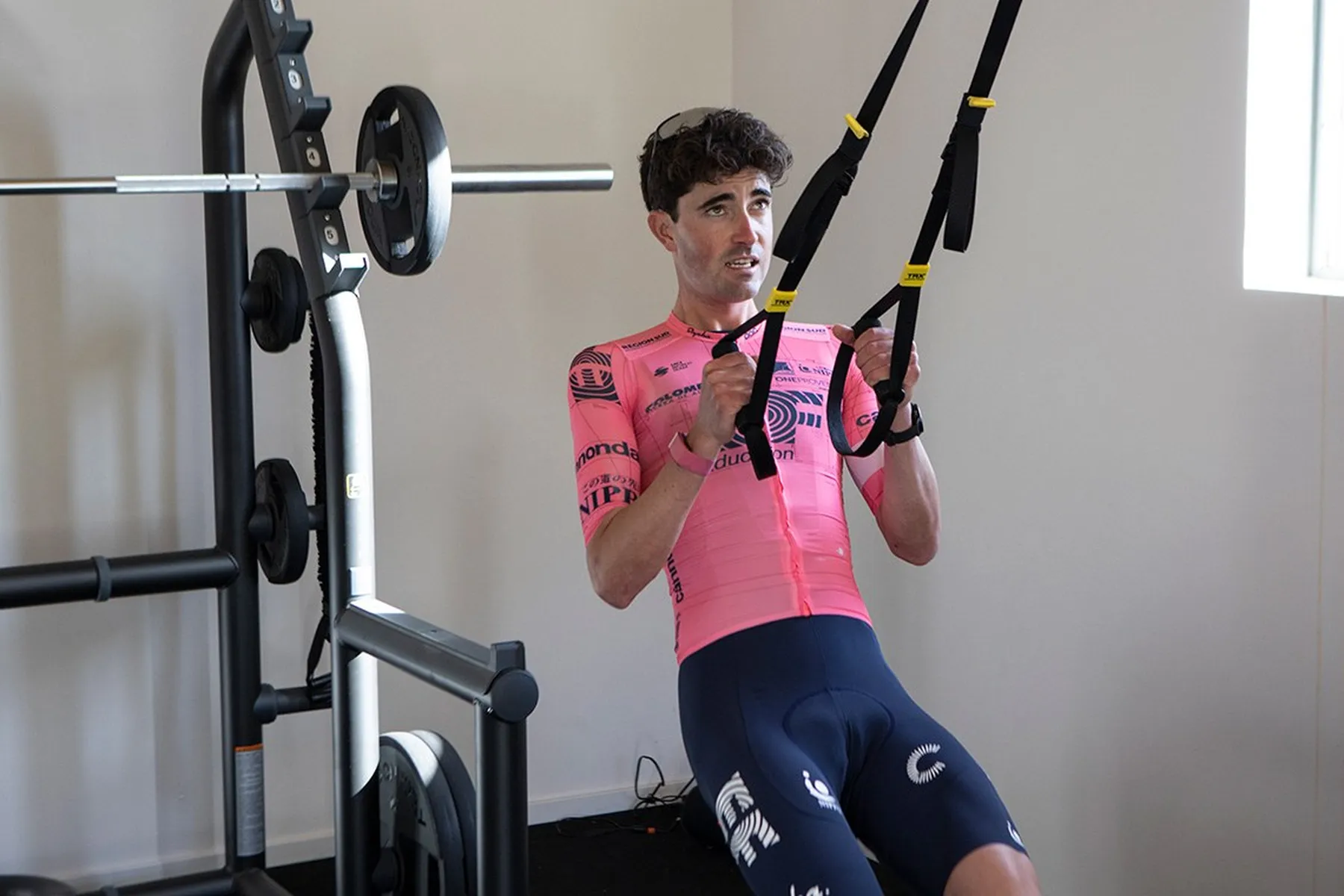
Why This Matters More After 40 Than It Does at 25
After age 40, adults lose roughly 3-8% of muscle mass per decade, with the rate accelerating after 70 (Volpi et al., 2004; Cruz-Jentoft & Sayer, 2019). That's published research, not opinion.
But it's not just total muscle mass. The fibers you lose fastest are your type 2 fibers — your fast-twitch muscle fibers. These are the ones responsible for explosive power, surges, closing gaps, standing on a steep climb and actually accelerating rather than just grinding over the top. Research on skeletal muscle ageing shows type 2 fibres shrink progressively with age while type 1 fibres are relatively spared — the differential atrophy is substantial in the 50s and deepens in sarcopenic older adults. If you're not doing anything to stimulate them, they keep going in that direction.
On top of that, VO2 max declines with age. For sedentary people, it drops roughly 10 to 12% per decade from age 40. If you're training well, you can cut that roughly in half — around 5 to 6% per decade. But even at the reduced rate, you're still declining. And if life gets busy and your training drops to mostly moderate intensity riding, the decline accelerates.
So you've got muscle disappearing, fast-twitch fibers shrinking, and your aerobic ceiling slowly coming down. What most cyclists do in response is ride a bit more. Same sessions, same effort, just more volume. That's exactly the wrong response — the common training mistakes from 1,400 podcast episodes post catalogues why "more miles" tends to fail at this age.
The meta-analysis answered this question directly. More time on the bike isn't the solution here. It's how you spend the time off it. The masters cycling training report 2026 goes deeper on the same data and the getting faster after 40 guide covers how to layer strength into the rest of the week.
Why Loaded Resistance Training Actually Transfers to the Bike
Loaded resistance training is one of the only ways to preserve and rebuild type 2 muscle fibers. Zone 2 riding won't do it. Even threshold intervals don't fully address this. The only way to maintain the fibers responsible for power and force production is to load them through resistance work.
The research points to three specific reasons this transfers to better cycling.
First, cycling efficiency improves. Your muscles get better at producing force, so each pedal stroke requires less metabolic cost. You're doing the same work with less effort. Over a two-hour ride or a four-hour road race, that adds up.
Second, rate of force development improves. That's how quickly your muscles can generate power. It's what lets you respond to surges, accelerate out of corners, and push over the top of a climb instead of getting slowly gapped. This is also one of the first things to decline with age, which is why older riders often feel like they've lost that snap even when their endurance feels fine.
Third, fatigue resistance improves. When your muscles are stronger, every pedal stroke represents a smaller percentage of your maximum capacity. The last hour of a ride feels different when your legs have reserves they didn't have before.
For riders over 40, the benefit is equal to or potentially greater than it is for younger riders, because you're actively fighting muscle loss that 25-year-olds don't have to think about yet. This isn't just an add-on. It's a direct countermeasure to the things that are actually slowing you down.
What the Studies Used — And What Roadman Recommends Instead
A note on translation. The studies in the meta-analysis used a variety of protocols. Many of them sat in the classical cycling-strength research tradition: lower-body bilateral barbell lifts (squat, leg press, conventional or trap-bar deadlift) at high load, low reps. That's the protocol that produces the biggest neuromuscular gains in supervised laboratory settings with athletes already competent under load.
It is not what we recommend as the prescribed Roadman protocol for our actual audience.
Roadman's audience is amateur cyclists 35-55 — most self-coached in the gym, with the hip-flexor tightness and posterior pelvic-tilt limitations that years of riding produce, with full-time work and family commitments, training 6-12 hours a week. For that population, max-effort bilateral barbell work carries an injury exposure that the research protocols control for through supervision and selection but most amateur riders can't replicate. A back tweak that costs you four weeks off the bike isn't a research outcome — it's a real cost that wipes out a block of training and tends to put cyclists off the gym permanently.
The Roadman approach is to deliver the same posterior-chain, single-leg, and core stimulus through cycling-specific patterns at meaningful, controlled, progressively loaded resistance. The principles the research validates — load matters, low rep ranges matter, two sessions a week matters, neuromuscular adaptation is the goal — apply just the same. The exercise selection is the part we adapt for the rider in front of us.
The Roadman Protocol
Two sessions per week. Each session, 30-40 minutes. Three to four exercises per session, three working sets each. Reps in the 6-10 range with a load you could do another 2-3 reps of with clean form. Real load — not bands, not bodyweight-only — but applied through patterns that match how cyclists actually need to be strong.
Sample session A:
- Single-leg Romanian deadlift, 3 × 8 each leg
- Bulgarian split squat, 3 × 8 each leg
- Hip thrust, 3 × 10
- Copenhagen plank, 3 × 20s each side
Sample session B:
- Kettlebell deadlift, 3 × 10
- Goblet squat, 3 × 10
- Step-up, 3 × 10 each leg
- Hanging core, 3 × 10
Why this shape:
- Single-leg dominance exposes and corrects the side-to-side imbalances cycling hides, and reduces spinal compression versus heavy bilateral barbell work.
- Hip-hinge patterns train the posterior chain — glutes, hamstrings, spinal erectors — that the pedal stroke under-loads.
- Hip thrusts load the glutes directly without putting load through the spine.
- Core integration is non-negotiable; the posterior chain doesn't function in isolation.
The best gym exercises for cyclists guide walks through technique points for each pattern. The Roadman strength training course builds these into a 12-week structured progression with video instruction.
This isn't bodybuilding. You're not doing sets of 15 with light weights. You're lifting with meaningful load through controlled, cycling-specific movement, with full recovery between sets. The load is the point — light strength training does not produce the same adaptations. But the load doesn't need to come from a max-effort bilateral barbell to deliver the stimulus.
The Mistake That Wipes Out Every Gain You've Built
Here's something the research is very clear on that most cyclists get completely wrong.
If you stop strength training for 6 to 8 weeks, the key adaptations — power output, rate of force development — return to baseline. They disappear. You're back to where you started.
This is why the off-season block approach fails almost every time. Cyclists do a few months of gym work in winter, feel the difference in spring, then drop it entirely when the race season starts. By mid-summer, the gains are gone.
The good news is that you don't need to keep doing two sessions a week year-round to hold onto what you've built. Research shows you can maintain most of the adaptations with as little as one session per week. One session. But you have to keep going. You cannot bank it and walk away.
For scheduling, give yourself at least 48 hours between a strength session and a key workout or race. A lot of riders find it works well to stack strength sessions on the same day as interval sessions rather than the day before or after a key ride. There's some individual preference here and it takes a bit of trial and error to find what works for your week. Retest your threshold every 8-12 weeks with the FTP Test Calculator to see the gains landing on the bike.
Key Takeaways
- A 2025 meta-analysis of 17 studies and 262 trained cyclists found strength training significantly improves cycling efficiency, anaerobic power, and time trial performance with no negative effect on VO2 max.
- After age 40, you lose roughly 8% of muscle mass per decade, with type 2 fibers shrinking 10 to 40% compared to younger adults — loaded resistance training is one of the only ways to counter this.
- Two sessions per week is the optimal frequency for trained cyclists.
- The Roadman protocol for amateur cyclists 35-55: cycling-specific patterns (split squats, hip hinges, single-leg deadlifts, hip thrusts, presses and core) at meaningful, controlled load. 6-10 rep range. Three to four exercises per session, three sets each. 30-40 minutes total.
- Adaptations disappear within 6 to 8 weeks of stopping — you cannot do a winter block and coast through the season.
- One session per week is enough to maintain the gains you've built once you're there.
If you want coaching that actually applies this research to your training — structured programming, strength sessions built around your riding week, the lot — that's exactly what NDY coaching at Roadman is built around for masters riders. The application is where the conversation starts.
For more on the over-50 picture specifically, the strength training for cyclists over 50 post and the VO2 max workouts for cyclists over 40 post round out the rest of the masters training picture.
Got a specific question about applying this to your own training week — when to schedule sessions, how to dose around hard rides, what to do if you've never lifted before? Ask Roadman for an answer drawn from the actual S&C and coaching conversations on the podcast.