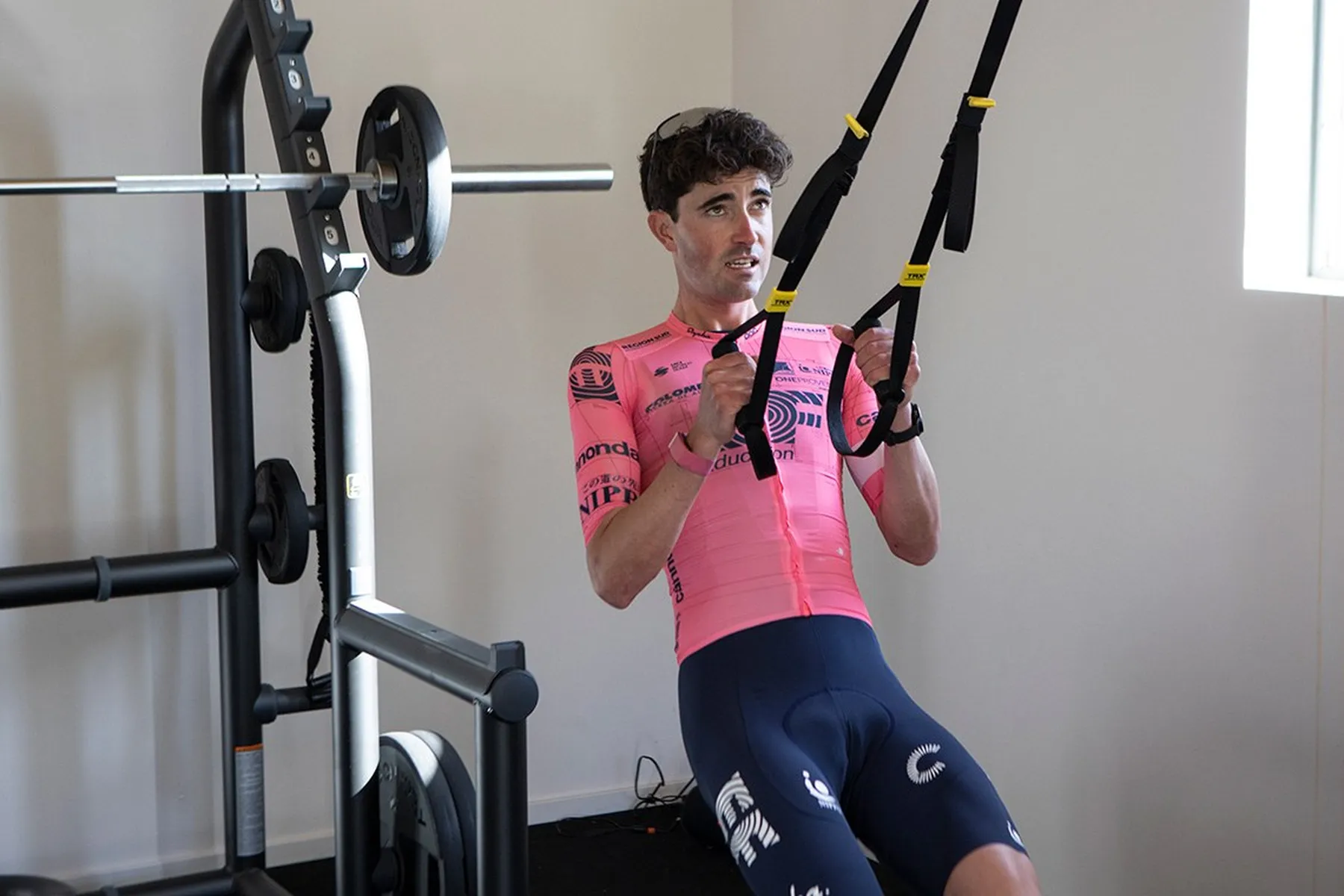
Most cycling-specific strength advice fails the rider for one reason: it asks too much. The plan that worked for a 22-year-old with 20 free hours a week does not survive contact with a 45-year-old with two kids and a job. The result is most cyclists either skip strength entirely or run a watered-down circuit-style session that doesn't drive the adaptation the bike actually benefits from.
The fix is not to ask for more time. It is to ask for the right time. The minimum effective dose for a cyclist who wants the performance benefit of strength training, without the gym becoming a second sport, is two short sessions per week. The protocol below is what we run with the Not Done Yet coaching community and what most of the strength specialists we've interviewed at length — Derek Teel chief among them — have converged on as the durable amateur-athlete prescription. For the long-form version of Teel's framework, see the best strength exercises for cyclists with Derek Teel.
Why the dose has shifted
The conversation about strength training for cyclists has moved over the last five years. The old debate — does strength help, hurt, or have no effect on cycling performance — has largely been settled by accumulating evidence.
The 2025 meta-analysis published on cycling-specific strength training, covering 17 trials and 262 trained cyclists, is the durable signal. It found structured strength training improves cycling performance with no negative effect on VO2 max. Time-trial performance, sprint power, and short-effort durability all improved. Body weight gain was negligible, and what gain occurred was lean tissue, not fat.
This is no longer a question worth arguing. The question now is what the minimum dose is to get the benefit, because the rider population is amateur cyclists with full lives, not fully-supported professional athletes.
The answer that has emerged: two sessions a week, with intent. One session a week is maintenance — useful in race week, not enough to drive progression in a build block. Three or more sessions a week deliver more, but the marginal gain past the second session is small relative to the time cost, and the recovery cost starts competing with the riding.
Two is the dose. Meaningful, controlled load is the intensity. The protocol below is the structure.
The protocol
Two 45-minute sessions per week. Four cycling-specific strength patterns. Three to five sets, six to ten reps per set, with 2-3 reps in reserve on the working sets. Rest 90 seconds to 2 minutes between sets. That's it.
The four patterns. For technique notes on each, see the best gym exercises for cyclists breakdown — the four below are the subset that earns the time.
-
Split squat. Rear-foot-elevated (Bulgarian) split squat or front-foot-elevated split squat. This is the cycling-specific lower-body driver: it loads one leg at a time, which is how the pedalling chain actually works, and it trains the glute, quad and hip-stabiliser pattern without the spinal load of a heavy bilateral barbell lift.
-
Hip hinge. Single-leg deadlift, kettlebell deadlift, or hip thrust. The hip-extension pattern that most amateur cyclists are weakest at. The single-leg variation directly mirrors the pedal stroke; the hip thrust isolates the glutes with very low spine loading. Pick the version your form is cleanest on.
-
Single-leg lower-body — secondary. Step-up or rear-foot-elevated lunge. A second unilateral pattern, complementary to the split squat, catching side-to-side asymmetries and reinforcing the single-leg drive of the bike.
-
Upper-body push-pull and core. Alternate sessions: a press (dumbbell shoulder press or push-up variation) one session, a row or pull-up the other. Add a 5-minute core finisher (Pallof press, dead bug, plank progressions). The upper body matters less for cyclists than the lower body, but a small amount of push-pull work catches postural issues that long hours in the saddle compound.
A typical session structure:
- 8-10 minutes warm-up: easy spin on a bike or rowing machine, dynamic mobility, two light warm-up sets of the first pattern.
- 12-15 minutes: pattern one (split squat or hinge), 4-5 sets per side at working load.
- 8-10 minutes: pattern two (the other of split squat/hinge), 3-4 sets.
- 8-10 minutes: pattern three (secondary single-leg), 3 sets per side.
- 6-8 minutes: pattern four (upper body) plus core, 3 sets.
- Total: 42-52 minutes including warm-up.
The two weekly sessions can both follow this structure, alternating which lower-body pattern is "pattern one." On Tuesday, the split squat goes first; on Friday, the hip hinge goes first.
Loading and progression
The intensity that matters: a load that challenges the muscle in the 6-10 rep range with 2-3 reps in reserve on the working sets. The goal is neuromuscular strength rather than muscle size, and that window is the well-established sweet spot for cyclists — heavy enough to recruit fast-twitch fibres and drive the strength adaptation, light enough that form holds and recovery doesn't compete with the bike.
Progression rule: when you can complete all sets at the prescribed reps with two reps left in reserve (RIR 2), add a small increment of load next session. Typical progression rate for a trained but cycling-primary rider: 1.25-2.5kg per session early on, settling to 0.5-1kg per session after 8-12 weeks.
If a session feels too hard — RIR 0 on the working sets, form starting to break down — reduce the load 5%, hold there for two sessions, then re-evaluate. Strength work tolerates the same overload-and-deload cycles training on the bike does.
Where the sessions go in the week
Three workable patterns.
Pattern one: stack hard work. Tuesday morning: hard ride. Tuesday evening: strength session. Wednesday: easy spin or rest. Friday morning: hard ride. Friday evening: strength session. Saturday: long ride. The benefit is that the next-day recovery cost of the strength work overlaps with the recovery from the ride; the cost is one tougher Tuesday and Friday.
Pattern two: separate days. Monday: strength. Tuesday: hard ride. Thursday: strength. Friday: easy. Saturday: long ride. Sunday: hard ride. Cleaner separation, more days with quality work but each one slightly less stacked. Works for riders who don't tolerate same-day double sessions well.
Pattern three: stacked alongside endurance. Tuesday: hard ride morning, strength evening. Friday: easy ride only. Saturday: long ride. Sunday: hard ride morning, strength evening. The Sunday strength session sits close to Monday recovery, so it works best when Monday is a true rest day.
The pattern that works for you depends on schedule constraints, recovery profile, and whether you actually have access to a gym at the times you need. The framework matters less than the consistency.
In-season vs out-of-season
The default amateur mistake is to drop strength entirely during the racing season because "the events take priority." This is the wrong call.
The published research is consistent: in-season strength maintenance preserves the gains made in pre-season. Cyclists who lift through the season hold their FTP improvements; cyclists who drop strength entirely lose roughly 30-40% of the strength-related performance gain within 8-12 weeks of stopping.
The in-season adjustment is simpler than most riders fear:
- Off-season (October-February in northern hemisphere). Two sessions per week, full protocol as described.
- Build season (March-May). Two sessions per week, full protocol. Minor adjustment: drop sets back to 3 per lift (from 4-5) to leave more recovery for the increased riding load.
- Race season (June-September). Two sessions per week through most of the season. Drop to one session per week, lighter load, in race week itself. Skip entirely only if the event is on Saturday or Sunday and the rider's weekly pattern doesn't support a Monday or Tuesday session afterwards.
This is consistent across the strength specialists we've recorded with — Derek Teel's framework on this is as good as any: the rider who lifts year-round preserves the benefit; the rider who runs strength as a winter project only sees the gains erode through the season they were earned for.
What this protocol is not
It is not a bodybuilding programme. The reps are wrong, the rest periods are wrong, the goal is wrong. Don't run an Arnold split alongside it.
It is not a Pilates-style stability programme. Those have a place but it is not for the strength adaptations cyclists need on the bike.
It is not bodyweight calisthenics or band work. These are useful for pre-rehab and warm-up; they are not the minimum effective strength dose for a trained cyclist who wants performance benefit.
It is not optional after 40. The 2025 meta-analysis is particularly compelling for the masters cohort, and Joe Friel's framework on this question — that strength shifts from optional to non-negotiable past 40 — is durably correct. The bone-density, lean-mass-preservation, and neuromuscular benefits compound across the decade.
The honest expectations
Strength training does not turn a 4.0 W/kg cyclist into a 5.0 W/kg cyclist on its own. It catches the 0.1-0.2 W/kg of gain that the bike-only training is leaving on the table, plus meaningful improvements in short-effort durability, sprint power, and end-of-ride power output when the legs would otherwise be ready to quit.
For a serious amateur, that's worth two 45-minute sessions a week.
The riders who keep getting faster in their forties and fifties are, almost without exception, the ones who lift. Not the ones who lift the most — the ones who lift consistently. Two sessions a week, four cycling-specific patterns, with meaningful and controlled load, applied across the year. That's the dose.
The argument about whether strength training helps cyclists is over. The work is to do it. If you'd rather follow a structured programme than self-build, the Roadman strength training course takes the protocol above and turns it into the actual sessions, week by week. For one-off questions on substitution, scheduling, or race-week tapers, the Roadman AI coach handles the narrow ones in seconds.